
Leading an organisation has qualities not unlike raising kids: long feedback loops, the power of example (and the comparatively low importance of demanding), and the direct reflection of your qualities and deficiencies. And that is no coincidence: you are guiding people. You want them to do the right thing, but also you want them to do it on their own terms.
This requires balancing freedom and structure. It requires leadership and management. Both hemispheres of the brain. Hence the name of this blog.
__________
"I can write job descriptions for my whole Senior Leadership Team, but not for myself. What is my job?"
I get this question frequently, and it's a great one. It shows self-reflection and scaling progress. Because every founder who asked me this used to know exactly what their job was. That certainty only faded when they started to work less in the company and more on it.
Being able to give hard feedback is seen as one of the marks of a strong founder. Some founders feel they're bad at it. Some take pride in it. Both these sentiments usually come from measuring oneself against the same picture: a leader who sits someone down and delivers tough words without flinching. It's a powerful image. But it's beside the point.
And that's because the purpose of hard feedback isn't the giving. It's the change. The purpose is to instil a behavioural change in another person — and that only happens if the feedback is received, understood and accepted. "Hard" plays only a limited role in any of those.
Hiring well is a core capability for any growth company. Yet most processes are too vague about what they're actually testing for.
Four things determine whether you get what you need: Mandate. Experience. Seniority. Potential.
Each answers a different question.
I used to think the worst employee was the incompetent but likeable one. Not good on the job and slow to improve, but — being a genuinely nice, warm and sensitive person — not one to easily give candid feedback to or let go. I thought this was the person holding back a team the most. I was mistaken. The worst employee is competent: it's the problem solver gone bad.
Often this person is an early employee — operationally strong, a reliable deliverer of results, indispensable to a founder early on. Naturally, they get promoted, given more responsibility, handed bigger problems. And that's when things can take a bad turn.
It only takes two ingredients.
Every day, we encounter behaviour we don't like. In most of life, the calculus is simple: Is pushing back worth the effort? Often, unless it‘s a real and acute nuisance, the answer is no. We just move on.
In a leadership context, the same instinct kicks in, but the calculus must be different. For two reasons – both worth understanding.
Scale is the lowest common denominator of business success. Scaling means generating more external output — revenue, customers served — from the same input: cost and people. Direction, business models, sales, branding, execution — these all matter enormously, but they vary too much across businesses and markets to generalise. Scaling is universal. Not success-critical for every company, but success-relevant for most (except for businesses that rely on highly individual or bespoke output).
There are only two ways an organisation can scale. (1) Individually: by becoming more efficient per operational unit, whether person or AI. (2) Collaboratively: when two or more operational units become more efficient at working together.
There are many hard choices as a founder. One of the hardest is choosing between being a CEO and being a person – a friend, a co-founder, the person people have gotten to know.
It's a choice that can't be avoided. It surfaces when people and roles separate, which they inevitably do in a startup: roles change fast. People, not always.
Workload Tetris is a popular game among leaders. I've played it. I thought I was good at it, too. The goal of the game is to squeeze maximum deliverables into the existing workforce by cleverly slicing and slotting work items. It feels satisfying. It feels like, by way of your skilled conducting, you are improving output. And early on, it's true – when a founder tells everybody what to do, it works. But as a company grows, Workload Tetris becomes the wrong tool. It still feels satisfying, which makes it hard to let go of. But instead of increasing output, it decreases it.
Here's why.
We sometimes confuse decisions with wishes. This happens because we distinguish based on our intent: we want to make a decision. Objectively, though, intent is meaningless. It is the execution that separates wishes from decisions: the execution of a wish is not on us – it’s either beyond our control or left to others. The execution of a decision, on the other hand, is on us. If we let go of it, we've really just made a wish.
As startups grow, decision-making and execution separate. This “execution gap” isn't a mistake – it's a necessity for growth: founders need to stop doing everything themselves. But if the gap isn’t managed, founders let go of execution. Without realising it, they start making wishes - and end up with poor status visibility and the nagging sense that nothing gets quite done.
Which choice sets athletes and amateurs apart? Athletes focus on training. Amateurs focus on playing.
Training is deliberate, often repetitive work to build or improve a specific skill. It is future-oriented.
Playing means applying existing skills in a competitive environment to win. It is present-oriented.
Training is why athletes remain competitive beyond the early talent phase and keep improving throughout their careers.
Founders are always at risk of not training enough.
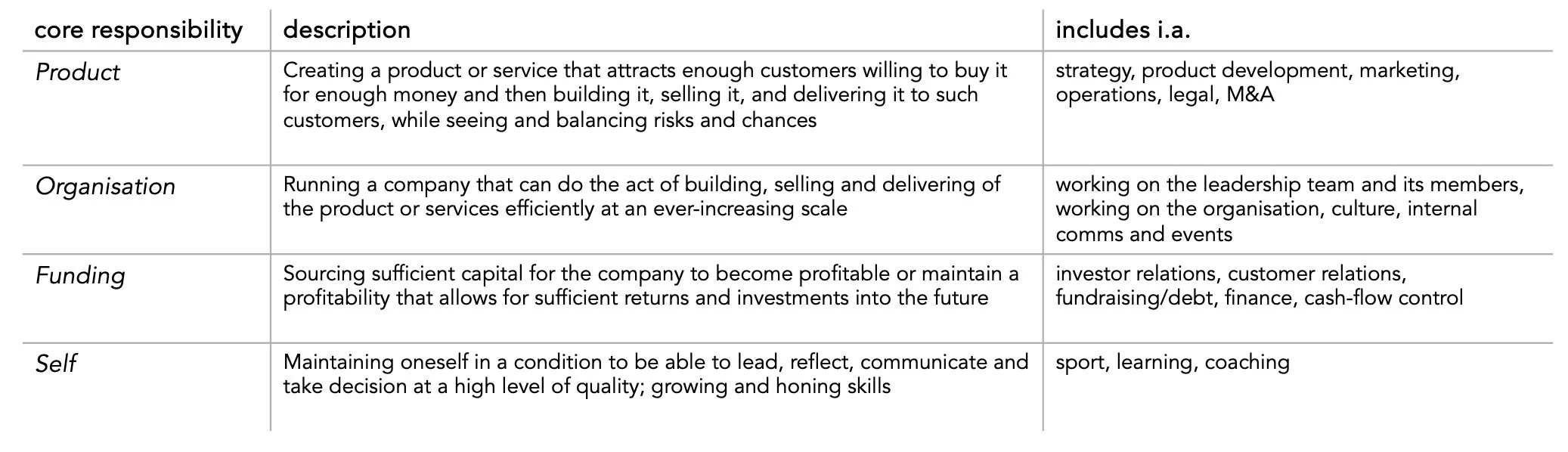
Congratulations, the bulk of the intellectual heavy lifting is in the bag. Now that the purpose and priorities of the one-on-one are clear, we can confidently proceed to determine the operational details. I’ll structure this section chronologically, as if you’d never had a one-on-one and are now setting one up for the first time, starting with the frequency and duration of all of the one-on-one series you will have, moving into how you can use a template to set up a particular one-on-one series, and finishing with some practical aspects of running a singular one-on-one meeting.
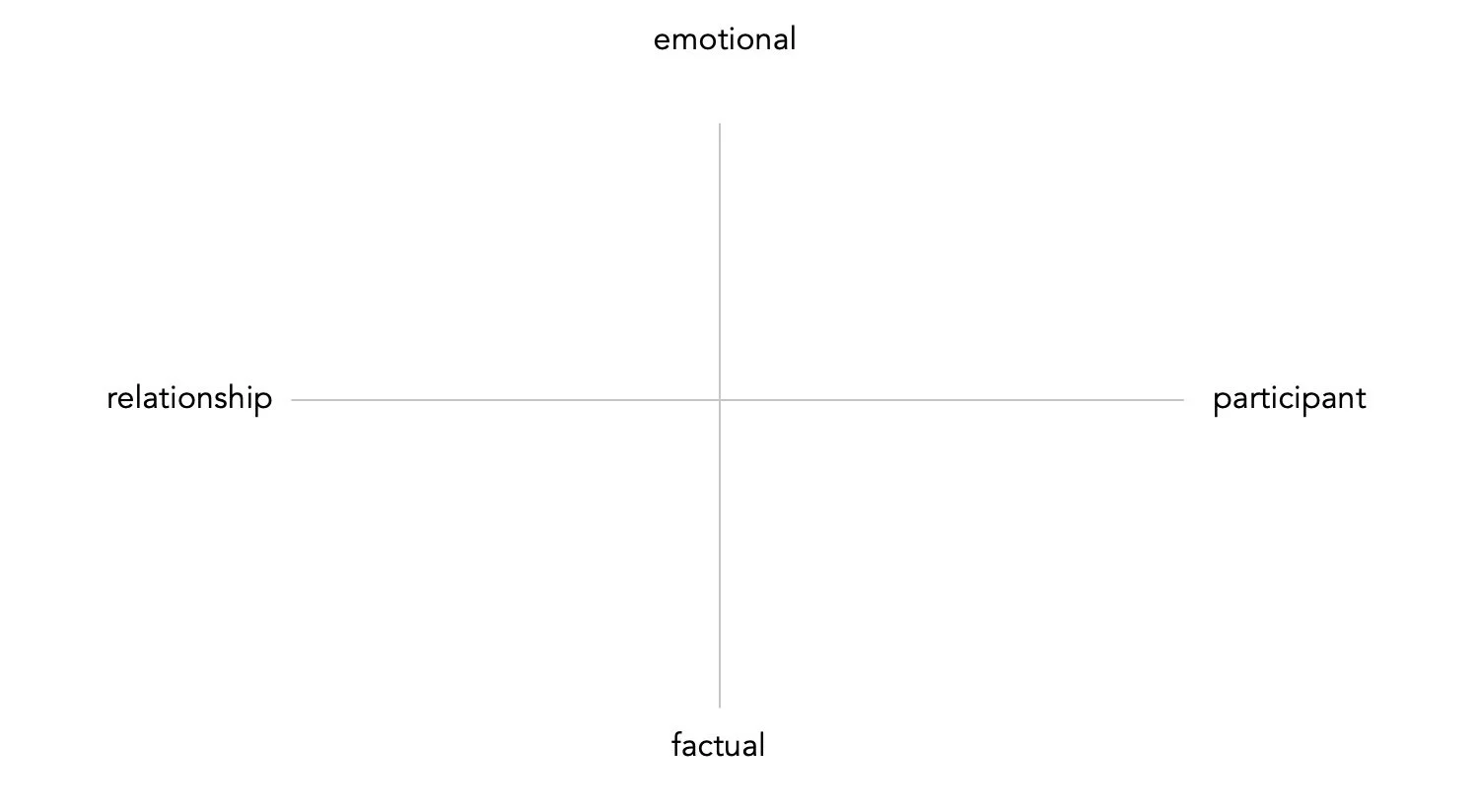
What topics shall we focus on in a one-on-one? A plethora of articles, texts and references exist on one-on-ones, providing a broad range of suggestions, ranging from career development to operational topics, dealing with workplace challenges, goal setting, feedback, private discussions and motivational issues.
Unfortunately, none of this helps. These examples are not necessarily wrong, but they are just that, examples. Without a logical derivation, taxonomy or priority, they provide no guidance for their application.
One-on-ones are the most basic type of meeting imaginable: two people talking with each other periodically. They are also the bread-and-butter artefact of leadership: a private, direct dialogue between a leader and a direct report.
Alas, from the perspective of a founder or CEO, they are quite the investment. You typically have more than one direct report, and your time is the most limited resource the company has (everything else can be sourced). By nature, the one-on-one does not scale. So there better be a good reason for you to take time for your direct reports individually and not as a group.

Europe is at a later-stage funding disadvantage compared to the US. There are a couple of reasons for this, mainly:
- There is simply more money in the US Venture Capital (VC) ecosystem,
- The majority of it gets deployed in later stages, in contrast to Europe and Germany, where the majority of investments are early-stage, and
- Tier 1 US VC firms, in particular, have bigger funds, allowing them to sign a greater number of larger tickets.
This is an issue because while money cannot buy success, it can - and it does - buy growth. Usually by way of (growth) marketing, sometimes through M&A activity, and often through outsized talent acquisition or frontloaded organisational growth.
Avoidance disguises itself. As respect: "I won't interfere with my co-founder's domain." As helpfulness: "I'm just jumping in to close a gap." As pragmatism: "Now isn't the time for that conversation."
Truth is, avoidance is neither altruistic nor pragmatic. It’s merely sidestepping a pain point. And just like physical avoidance can lead to lasting postural damage (compensating for a sore knee can cause hip or spine problems), leadership avoidance can create structural problems far worse than the original discomfort.